


Chlorella vulgaris U-1
Chlorophyta › Trebouxiophyceae › Chlorellales › Chlorellaceae › Chlorella
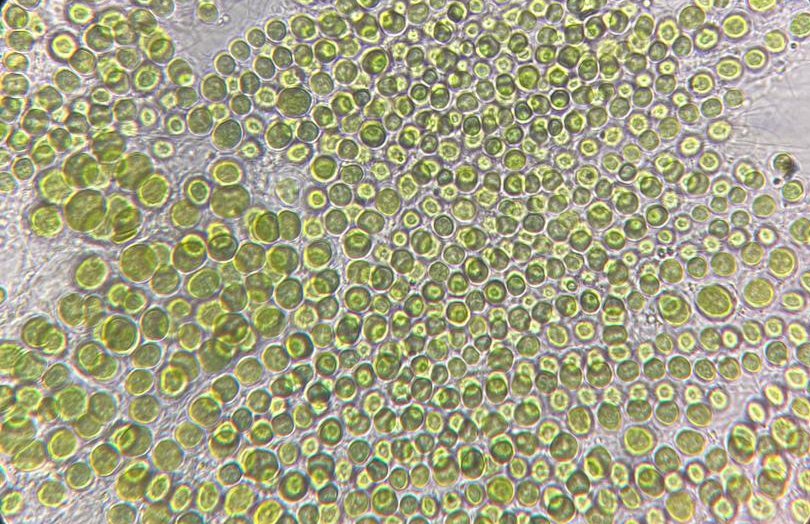
Description
History of Receipt and Isolation
- Country of origin: Republic of Kazakhstan
- Place of isolation: East Kazakhstan Region, Lake Alakol
- Habitat: brackish waters of Lake Alakol
- Isolator(s): Zayadan B.K., Bolatkhan K., Kakimova A.B. in the Biotechnology Laboratory of Al-Farabi Kazakh National University.
- Year of accession to the collection: 2021
- Method of obtainment: Isolated from an enrichment culture obtained from a natural sample by sequential microbiological streaking.
- Genetic features: Wild type (WT)
- Culture state: axenic
Morphology and Structure
The cells of the strain are spherical, with a thin cell wall, a broadly band-shaped (girdle-shaped) chromatophore, and visible vacuoles. The cell diameter ranges from 1.7 to 6.7 μm, occasionally reaching up to 15 μm, while the diameter of the mother cell containing daughter cells is up to 28 μm. The cells are uninucleate with a solitary, band-like parietal chloroplast. A pyrenoid is absent.
Cultivation
- Nutrient medium: BG-11 medium (liquid and agar-solidified)
- Temperature: +25 °C
- Light intensity: 50–100 µmol photons/m²/s
- Light regime: 16:8 h (light/dark)
- pH: 7.5
Physiological Characteristics
mesophile, photoautotroph.
Long-term Preservation Conditions
maintained on liquid and 1.5–2.0% agarized mineral BG-11 medium. Storage temperature: 12–15 °C; light intensity: 5–10 μmol photons/m²/s; photoperiod: 12:12 h (light/dark). Culture subculturing is performed every 3 months.
Deposition Information
deposited in 2021 into the Republican Collection of Microorganisms of the Republic of Kazakhstan. Registration Number: RKM 0959
Field of Application
in fundamental research and biotechnology.