


Chlorella sp.
Chlorophyta › Trebouxiophyceae › Chlorellales › Chlorellaceae › Chlorella
Description
History of Receipt and Isolation
- Country of origin: Republic of Kazakhstan.
- Site of isolation: Aktau, industrial zone of the oil refinery, production facilities, sampling point M-13 (at the inlet from the production units).
- Habitat: Petroleum-contaminated wastewater from industrial facilities.
- Isolator(s): B.K. Zayadan and A.A. Dauletova, Bolatkhan K. at the Biotechnology Laboratory of Al-Farabi Kazakh National University
- Year of accession to the collection: 2024.
- Method of obtainment: isolated from an enrichment culture obtained from a natural sample by sequential microbiological streaking
- Genetic features: Wild type
- Culture condition: Axenic.
Morphology and Structure
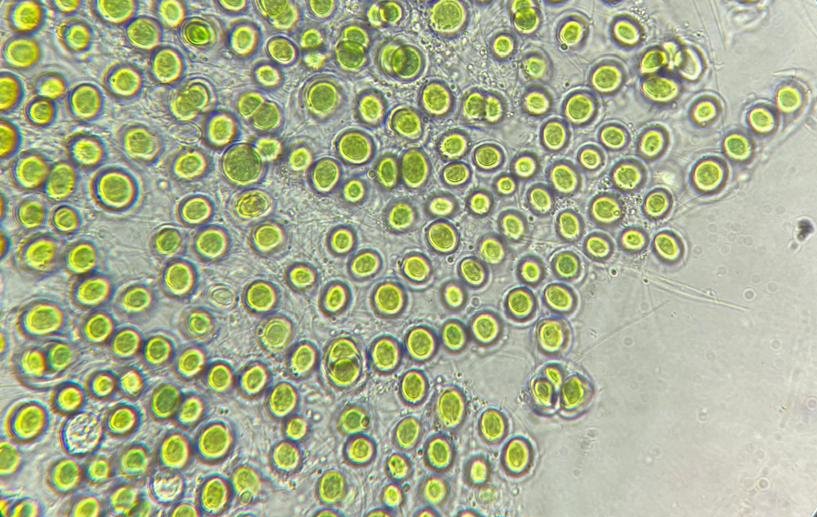
Cells are solitary, non-motile, eukaryotic, spherical or slightly ovoid, and measuring 2–10 μm in diameter. The cell wall is smooth, rigid, and bilayered, consisting primarily of cellulose and hemicellulose; in some strains it also contains the hydrolysis-resistant biopolymer algaenan. Mucilaginous sheaths, spines, projections, and flagella are absent. Each cell contains a single large parietal cup-shaped or trough-shaped chloroplast with one distinct pyrenoid surrounded by a starch sheath. The cytoplasm contains a single nucleus, mitochondria, vacuoles, and lipid inclusions, the abundance of which increases under stress conditions. Reproduction occurs exclusively by asexual formation of 2–8 (rarely up to 16) autospores within the mother cell, followed by rupture of the mother cell wall and release of the daughter cells. According to the plankton size classification (Dussart scale), the strain belongs to the nanoplankton size fraction (2–20 μm).
Cultivation
- culture medium: BG-11 medium
- temperature: 24–28 °C
- light intensity: 60–150 µmol photons/m²/s
- photoperiod: 16 h light / 8 h darkness
- pH of the medium: 6.8–7.5
Physiological Characteristics
Halotolerant.
Long-term Preservation Conditions
maintained in the working collection on mineral BG-11 medium (liquid or 1.5% agarized) at a temperature of 12–15 °C, under low light intensity (5–10 μmol photons/m²/s), and with a 12-hour light / 12-hour dark photoperiod. Medium-term storage on a specialized rack with routine culture subculturing every 3 months is considered optimal; storage in a refrigerator at 4–8 °C is also acceptable, provided that the cultures are not kept in complete darkness.
Genetic Information
GenBank Accession №PZ759673
Field of Application
Utilized in fundamental research and biotechnology.