


Desertifilum sp. IPPAS B-1220
Cyanobacteriota › Cyanophyceae › Desertifilales › Desertifilaceae › Desertifilum
Description
History of Receipt and Isolation
- Country of origin: Mongolia
- Place of isolation: Lake Shara-Nur (Shar Nuur), Mongolia
- Habitat: freshwater lake
- Isolator(s): Bolatkhan K.
- Year of accession to the collection: 2013
- Method of obtainment: Isolated from an enrichment culture obtained from a natural sample by sequential microbiological streaking
- Genetic features: wild type
- Strain condition: axenic
Morphology and Structure
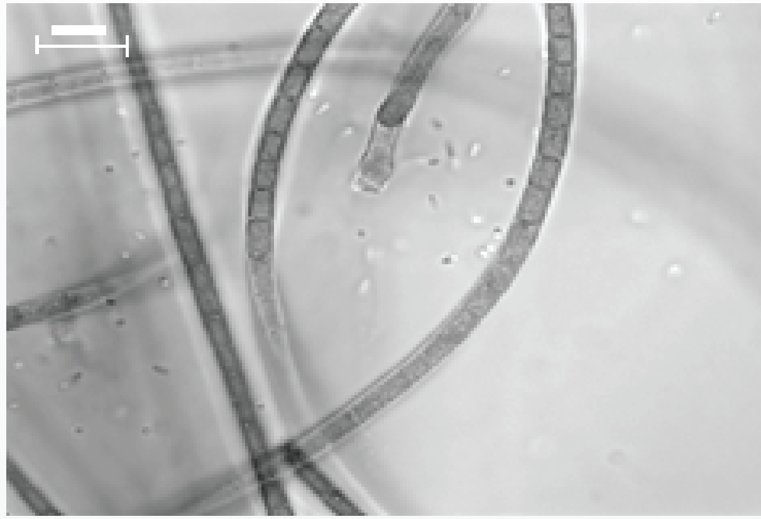
Cells of the culture are filamentous, with a thin colorless sheath. Trichomes are single, uniseriate, straight, dark blue-green, slightly constricted at the transverse septa, 2.0–3.0 (up to 3.5) µm wide, sometimes slightly curved towards the ends. Cells are barrel-shaped or cylindrical, isodiametric to elongate, 2.5–5.4 µm long and 2.5–3.5 µm wide. Trichomes form strands arranged relatively parallel. The suspension is blue-green in mass, slightly mucous; when stirring is stopped, a sediment forms easily, and the culture settles completely within 40 min; the sediment is amorphous, easily resuspended, with complete resuspension within 40 min–1 h.
Cultivation
- Nutrient Medium: BG-11 (liquid and agarized)
- Temperature: 28 °C (optimum; growth range 25–32 °C)
- Light intensity: photophilic
- Photoperiod: up to 16–18 h light per day.
- pH: 7.0
Physiological Characteristics
neutrophile, mesophile, light-loving, autotroph. Notes: contains a large amount of 7,10-16:2 fatty acids, rarely found in cyanobacteria; on agarized BG-11 medium forms blue-green interweavings of trichome filaments.
Long-term Preservation Conditions
maintained on liquid and 1.5–2.0% agarized mineral BG-11 medium. The preservation temperature is 12–15 °C, light intensity is 5–10 µmol photons/m²/s, with a 12:12 h (light/dark) photoperiod. Subculturing (transfer) is performed every 3 months.
Deposition Information
maintained in another world collection under the number IPPAS B-1220 in the Collection of Microalgae and Cyanobacteria at the K.A. Timiryazev Institute of Plant Physiology of the Russian Academy of Sciences (Russia).
Genetic Information
Nucleotide sequences in the NCBI database: ASM174691v1 (draft genome).
Field of Application
In fundamental research and biotechnology; of interest as a thermotolerant strain and a source of rare fatty acids.
Bibliography
- González-Resendiz L., Johansen J.R., León-Tejera H., Sánchez L., Segal-Kischinevzky C. et al. A bridge too far in naming Species – a total evidence approach does not support recognition of four species in Desertifilum (Cyanobacteria). J Phycol 2019; 55: 898–911. doi: 10.1111/jpy.12867
- Sinetova M.A., Bolakhan K., Sidorov R.A., Mironov K.S., Skrypnik A.N., Kupriyanova E.V., Zayadan B.K., Shumskaya M.A., Los D.A. Polyphasic characterization of the thermotolerant cyanobacterium Desertifilum sp. strain IPPAS B-1220. FEMS Microbiol. Lett. 2017; 364(4): fnx027
- Mironov K.S., Sinetova M.A., Bolatkhan K., Zayadan B.K., Ustinova V., Kupriyanova E.V., Skrypnik A.N., Gogoleva N.E., Gogolev Y.V., Los D.A. Draft genome sequence of the thermotolerant cyanobacterium Desertifilum sp. IPPAS B-1220. Genome Announc. 2016; 4(6): e01304-16. doi: 10.1128/genomeA.01304-16
Patents and Other Intellectual Property
Utility model patent No. 2276 — "Strain Desertifilum sp. IPPAS B-1214 as a raw material for obtaining chlorin Е6." Authors: Bolatkhan K., Sadvakassova A. K., Akmukhanova N. R., Zayadan B. K., Bilal S. The production of chlorin E6 for medical and pharmaceutical purposes is achieved using the biomass of Desertifilum sp. IPPAS B-1214, which is capable of accumulating chlorophyll a in large quantities and growing productively over a wide range of temperatures.