


Trichormus variabilis K-31
Cyanobacteria › Cyanophyceae › Nostocales › Trichormus
Description
History of Receipt and Isolation
- Country of origin: Republic of Kazakhstan
- Site of isolation: village of Avangard, Zhanakorgan District, Kyzylorda Region
- Habitat: rice fields and aquatic ecosystems
- Isolator(s): Sadvakasova A.K., Zayadan B.K., Kossalbayev B.D., Bauenova M.O. at the Biotechnology Laboratory of Al-Farabi Kazakh National University
- Year of accession to the collection: 2022
- Last identification: Sadvakasova A.K., Zayadan B.K., Kossalbayev B.D., Bauenova M.O., 2023
- Method of obtainment: isolated from an enrichment culture obtained from a natural sample by sequential microbiological streaking
- Genetic features: Wild type (WT)
- Strain condition: Axenic
Morphology and Structure
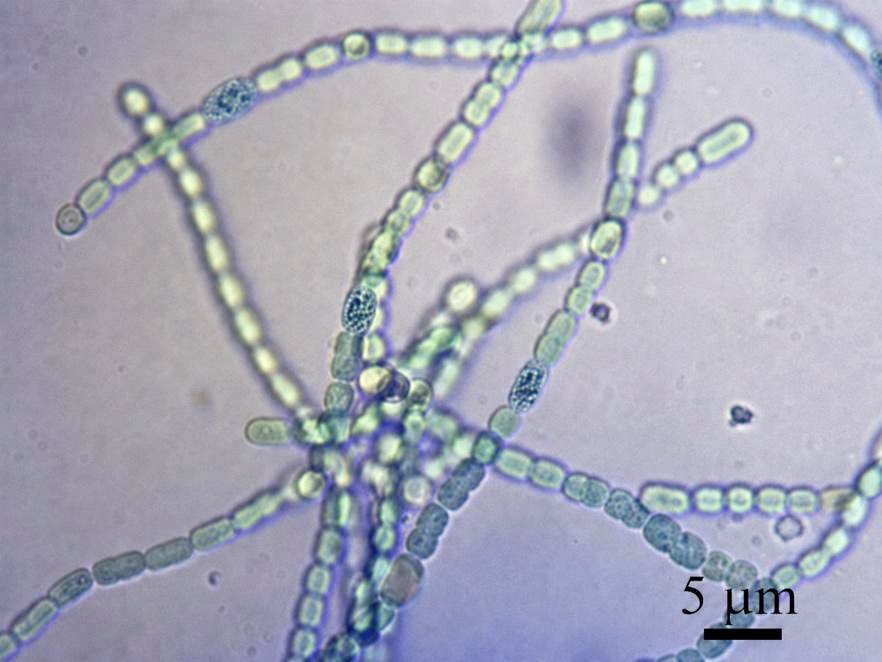
Trichomes are solitary, filamentous, straight or slightly curved. Vegetative cells are cylindrical, barrel-shaped, or spherical, pale blue, light blue, or olive-green; sometimes with gas vacuoles or granular contents. Terminal cells are slightly elongated and non-vacuolated. Heterocysts are intercalary, solitary, oval or spherical, slightly larger than vegetative cells; they form during medium depletion on days 8–15 of cultivation. Akinetes are spherical, solitary, and located between two heterocysts. Reproduction occurs by hormogonia. On solid medium, the strain forms mucilaginous colonies; in liquid medium, it forms mucilaginous amorphous clumps, settles, and grows along the flask walls.
Cultivation
- Nutrient media: Allen's, BG-11, Chu-10, Bold's (liquid and agarized)
- Temperature: 25–28 °C
- Light intensity: 30–40 µmol photons/m²/s
- Photoperiod: 16:8 h (light/dark)
- pH: 7.0–7.5
Physiological Characteristics
Mesophilic heterocystous nitrogen-fixing cyanobacterium. It is characterized by active formation of heterocysts and akinetes under medium depletion. In nitrogen fixation experiments, this strain showed the highest acetylene reduction activity among the studied strains: 3.57 ± 0.26 nmol ethylene mg⁻¹ dry weight h⁻¹.
Long-term Preservation Conditions
stored on agarized mineral BG-11 medium at 20 ± 2 °C under low illumination (300–500 lux). Maximum storage period: 2–3 months.
Deposition Information
The strain was deposited in the Republican Collection of Microorganisms under the Ministry of Education and Science of the Republic of Kazakhstan. Date of deposition: 20.10.2021. Collection number: RKM-0967.
Genetic Information
A fragment of the 16S rRNA gene was amplified. BLAST similarity with Trichormus variabilis: 99–100%. The phylogenetic tree was constructed in MEGA 6 using the Neighbor-Joining method and the Kimura-2-Parameter model; the outgroup was Chlorella antarctica KU291887.1. GenBank accession number: MZ079356.
Field of Application
The strain is used in experimental studies. It is promising for the development of biofertilizers, soil nitrogen enrichment, improvement of crop productivity, bioremediation, and algal-cyanobacterial biofilm formation.
Bibliography
- Sadvakasova A.K. et al. Influence of Mo and Fe on Photosynthetic and Nitrogenase Activities of Nitrogen-Fixing Cyanobacteria under Nitrogen Starvation. Cells. 2022; 11(5):904. DOI: 10.3390/cells11050904.
Patents and Other Intellectual Property
Utility model patent No. 7247. Application No. 2022/0413.2 dated 13.05.2022. Publication date: 01.07.2022. Title: “Trichormus variabilis K-31 cyanobacterium strain intended for nitrogen enrichment of soil and improving crop yields.” Patent holder: Al-Farabi Kazakh National University, Non-profit Joint-Stock Company. Authors: Sadvakasova A.K., Bauenova M.O., Zayadan B.K., Kossalbayev B.D., Kirbayeva D.K., Ybray S.N., Nuralibekov S.Sh.