


Phormidium sp.
Cyanobacteria › Cyanophyceae › Phormidiales › Phormidiaceae › Phormidium
Description
History of Receipt and Isolation
- Country of origin: Republic of Kazakhstan.
- Site of isolation: Industrial zone of the oil refinery, Aktau, Kazakhstan; production facilities, sampling point M-13 (inlet from the production units).
- Habitat: Oil-contaminated wastewater
- Isolator(s): B.K. Zayadan and A.A. Dauletova, B.K. Zayadan and A.A. Dauletova, K.Bolatkhan at the Biotechnology Laboratory of Al-Farabi Kazakh National University
- Year of accession to the collection: 2024.
- Method of obtainment: isolated from an enrichment culture obtained from a natural sample by sequential microbiological streaking
- Culture purity: axenic
Morphology and Structure
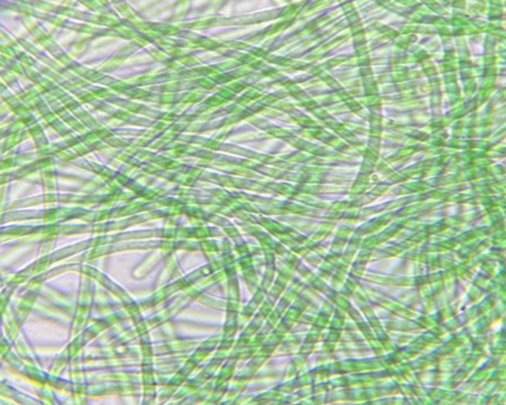
forms single-row, straight or slightly curved, unbranched filaments (trichomes) of a blue-green color. Vegetative cells are discoid or broadly cylindrical in shape, with their width significantly exceeding their length. The filaments are surrounded by thin, delicate mucous sheaths, while specialized cells (heterocysts and akinetes) are completely absent. According to the size classification of plankton, individual cells belong to nanoplankton (2–20 μm).
Cultivation
- culture medium: BG-11 medium
- temperature: 20–24 °C
- light intensity: 40–80 µmol photons/m²/s
- photoperiod: 16 h light / 8 h darkness
- pH of the medium: 7.5–8.2.
Physiological Characteristics
Alkalitolerant neutrophile.
Long-term Preservation Conditions
maintained in the working collection on BG-11 medium (liquid or 1.0–1.5% agarized) at a temperature of 12–15 °C, under low light intensity (5–10 μmol photons/m²/s), and with a 12-hour light / 12-hour dark photoperiod. Storage on a specialized rack with routine culture subculturing every 2.5–3 months is considered optimal. Decreasing the storage temperature below 10 °C (including domestic refrigerators at 4–8 °C) is not permitted due to the risk of strain death.
Genetic Information
GenBank Accession №PZ747268
Field of Application
in fundamental research and biotechnology.