


Chlorella sp. 1
Chlorophyta › Trebouxiophyceae › Chlorellales › Chlorellaceae › Chlorella
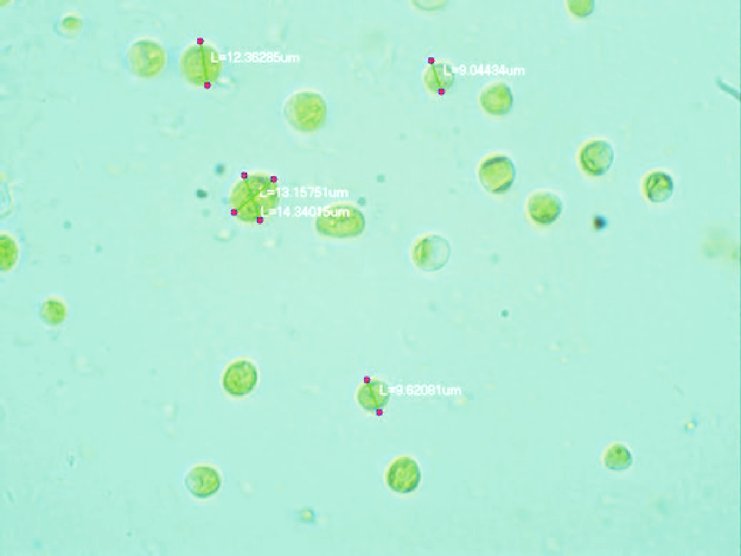
Description
History of Receipt and Isolation
- Country of origin: Mongolia
- Place of isolation: Provided by the collection of the Institute of Biotechnology, Academy of Sciences, (Mongolia)
- Last determination: Zayadan B.K., Akmukhanova N.R. in the Laboratory of Biotechnology of al-Farabi Kazakh National University, 2015
- Year of accession to the collection: 2001, IPPAS
- Isolator(s): Zayadan B.K.
- Method of obtainment: collection strain
- Genetic features: wild type
- Strain condition: axenic
Morphology and Structure
Cells are spherical. The cell wall is thick. Cell diameter varies depending on the age and developmental stage: autospores are 2.5–4.0 µm, young vegetative cells are 5.0–10.0 µm, and mature cells range from 1.7 to 14.0 µm. The chromatophore is narrow and band-shaped (incomplete) or may be plate- or cup-shaped; it contains a pyrenoid. The cytoplasm contains one or several vacuoles.
Cultivation
- Culture medium: Tamiya mineral medium (liquid and agarized)
- Temperature: 24–28 °C
- Light intensity: 50–100 µmol photons/m²/s
- Light regime: 16:8 h (light/dark)
- pH of the medium: 6.0–7.0
Physiological Characteristics
Mesophile, autotroph, neutrophile. Under optimal cultivation conditions for biomass production (in Tamiya medium at 26–28 °C, pH 6.5, and continuous CO₂ supply) over 7–8 days, the content of substances in 1.5–2.0 g/L of dry biomass is as follows: proteins – 48–50%, carbohydrates – 40–45%.
Long-term Preservation Conditions
Stored on liquid and 1.5–2.0 % agarized Tamiya mineral medium. Storage temperature 10–12 °C, light intensity 10–20 µmol photons/m²/s, photoperiod 12:12 h (light/dark). Subculturing is carried out as needed, but at least once every 2–4 months.
Deposition Information
Deposited in 2003 in the Republican Collection of Microorganisms of the Republic of Kazakhstan. Registration number - A-RKM 0120.
Field of Application
In fundamental research and biotechnology.
Bibliography
- Буянхишиг, Н., & Заядан, Б. К. (1989). Результаты определения автоспора и длительности клеточного цикла культуры одноклеточных зеленых водорослей Chlorella sp. Научные труды Института общей и экспериментальной биологии, 24, 24–29.
- Zayadan, B. K. (1991). Passportization of mutant strains of Chlorella sp. /Catalog of Microalgae Cultures in USSR Collections (p. 27). Moscow.
- Заядан, Б. К., & Өнерхан, Г. (2010). Бурабай және Қопа көлдері суларына микробалдыр Chlorella sp.-1 штамы көмегімен био-тест жүргізу. ҚазҰУ хабаршысы. Экология сериясы, (4), 97–101.
- Заядан, Б. К. (2001). Жасыл балдырлар Chlorella клеткаларының ауыр металдарға төзімділігі мен олардың биомассасындағы цистеин мөлшері арасындағы қатынасты зерттеу нәтижелері. Вестник КазГУ. Серия биологическая, (2), 117–121.
- Заядан, Б. К. (2001). Су экожүйелеріне биологиялық тест жүргізуге жасыл балдыр Chlorella sp.-1 табиғи түрін пайдаланудың маңызы. Вестник КазГУ. Серия экологическая, 2(14), 140–144.