


Ankistrodesmus falcatus B-5
Chlorophyta › Chlorophyceae › Sphaeropleales › Selenastraceae › Ankistrodesmus
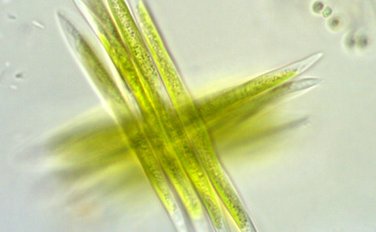
Description
History of Receipt and Isolation
- Country of origin: Republic of Kazakhstan
- Place of isolation: East Kazakhstan Region, Lake Alakol.
- Habitat: brackish waters
- Isolator(s): Zayadan B.K., Bolatkhan K., Kakimova A.B. in the Biotechnology Laboratory of Al-Farabi Kazakh National University.
- Year of accession to the collection: 2021.
- Method of isolation: isolated from an enrichment culture obtained from a natural sample by sequential microbiological streaking.
- Genetic features: Wild type (WT)
- Strain condition: Axenic.
Morphology and Structure
cells are acicular to narrowly fusiform, straight or slightly curved, gradually tapering toward acute apices. Cells occur singly or form fasciculate bundles, usually consisting of 2–4–8 cells. Spines are absent. A single parietal chloroplast occupies a substantial part of the cell periphery and usually lacks a pyrenoid. A nucleus with a nucleolus, mitochondria, and starch inclusions can be distinguished within the cells.
Cultivation
- Nutrient medium: BG-11 medium (liquid and agar-solidified)
- Temperature: +25 °C
- Light intensity: 50–100 µmol photons/m²/s
- Light regime: 16:8 h (light/dark)
- pH: 7.0
Physiological Characteristics
mesophile, photoautotroph.
Long-term Preservation Conditions
maintained on liquid and 1.5–2.0% agarized mineral BG-11 medium. Storage temperature: 12–15 °C; light intensity: 5–10 μmol photons/m²/s; photoperiod: 12:12 h (light/dark). Culture subculturing is performed every 3 months.
Deposition Information
certificate of deposition of microorganism No. 09/12-397 in 2021 into the Republican Collection of Microorganisms of the Republic of Kazakhstan. Registration Number: RKM 0961
Genetic Information
none
Field of Application
in fundamental research and biotechnology.
Bibliography
- Сарсекеева, Ф. К., Болатхан, К., Сапархан, Е. С., Сандыбаева, С. К., Амантаева, А. Т., & Заядан, Б. К. (2022). Возможности использования термальных и минеральных источников Республики Казахстан как среды для культивирования микроводорослей – продуцентов биодизеля. Eurasian Journal of Ecology, 71(2), 34–43. https://doi.org/10.26577/eje.2022.v71.i2.04