


Anabaena variabilis A-1
Cyanobacteria › Cyanophyceae › Nostocales › Nostocaceae › Anabaena
Description
History of Receipt and Isolation
- Country of origin: Republic of Kazakhstan.
- Site of isolation: Zhanakorgan
- Habitat: rice fields.
- Isolator(s): Kakimova A.B., Zayadan B.K., Bolatkhan K., Sadvakasova A.K., and Sandybayeva S.K. in the Biotechnology Laboratory of Al-Farabi Kazakh National University.
- Year of accession to the collection: 2021.
- Method of obtainment: isolated from an enrichment culture obtained from a natural sample by sequential microbiological streaking.
- Genetic features: Wild type (WT)
- Strain condition: Axenic.
Morphology and Structure
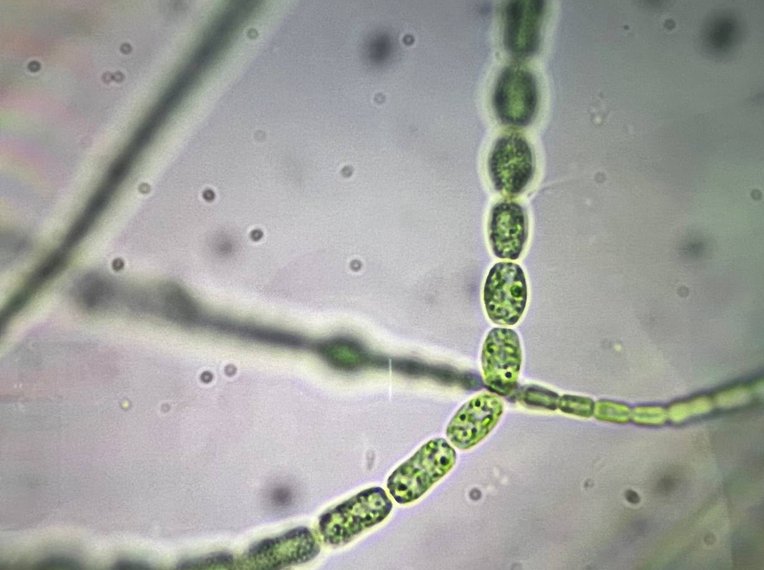
The strain is a filamentous cyanobacterium. The trichomes are often entangled, whereas solitary trichomes consist of spherical cells, among which heterocysts and rare, barely visible akinetes are observed. The trichomes are not attenuated at the ends, present more or less deep constrictions at the cross-walls, and are covered by mucous sheaths. The cells are cylindrical, barrel-shaped, or spherical, pale or bright blue-green to olive in color, either containing gas vesicles (vacuoles) or lacking them, but occasionally with granular contents. Terminal cells are slightly elongated and non-vacuolated. Heterocysts are intercalary, solitary, spaced at certain distances from one another, oval or sometimes spherical, and typically slightly larger than vegetative cells. The development of heterocysts was observed under nutrient depletion conditions on the 8th–15th day of cultivation.
Cultivation
- Nutrient medium: BG-11₀ medium (liquid and agar-solidified)
- Temperature: +25 °C
- Light intensity: 50–100 µmol photons/m²/s
- Light regime: 16:8 h (light/dark)
- pH: 7.0–8.0
Physiological Characteristics
mesophile, photoautotroph.
Long-term Preservation Conditions
maintained on liquid and 1.5–2.0% agarized mineral BG-11 medium. Storage temperature: 12–15 °C; light intensity: 5–10 μmol photons/m²/s; photoperiod: 12:12 h (light/dark). Culture subculturing is performed every 3 months.
Deposition Information
certificate of deposition of microorganism No. 09/12-396 in 2021 into the Republican Collection of Microorganisms of the Republic of Kazakhstan. Registration Number: RKM 0960
Field of Application
capable of biohydrogen (H₂) production, nitrogen fixation, and use in biotechnological processes. Promising for renewable energy, biohydrogen technologies, and environmentally friendly biotechnological production. The strain was obtained within research funded by the Ministry of Education and Science of the Republic of Kazakhstan under projects AP09260785 and AP08052481.
Bibliography
- Kossalbayev, B. D., Kakimova, A. B., Bolatkhan, K., Zayadan, B. K., Sandybayeva, S. K., Bozieva, A. M., Sadvakasova, A. K., Alwasel, S., & Allakhverdiev, S. I. (2022). Biohydrogen production by novel cyanobacterial strains isolated from rice paddies in Kazakhstan. International Journal of Hydrogen Energy, 47(37), 16440–16453. https://doi.org/10.1016/j.ijhydene.2022.03.126
Patents and Other Intellectual Property
Kakimova A.B., Zayadan B.K., Bolatkhan K., Sadvakasova A.K., Sandybayeva S.K., Anabaena variabilis A-1 strain used as a raw material for biofuel production: utility model patent of the Republic of Kazakhstan No. 8167; publ. 01.03.2024.