


Nostoc sp.
Cyanobacteria › Cyanophyceae › Nostocales › Nostocaceae › Nostoc
Description
History of Receipt and Isolation
- Country of origin: Republic of Kazakhstan.
- Place of isolation: Aktau, industrial zone of the Oil Refinery, production units, sampling point M-4 (at the outlet of the production units)
- Habitat: Oil-contaminated wastewater
- Isolator(s): B.K. Zayadan, A.A. Dauletova, K.Bolatkhan at the Biotechnology Laboratory of Al-Farabi Kazakh National University
- Year of accession to the collection: 2024.
- Method of obtainment: Isolated from an enrichment culture obtained from a natural sample by sequential microbiological streaking onto solid nitrogen-free nutrient medium
- Genetic features: Wild type (WT)
- Culture condition: Axenic
Morphology and Structure
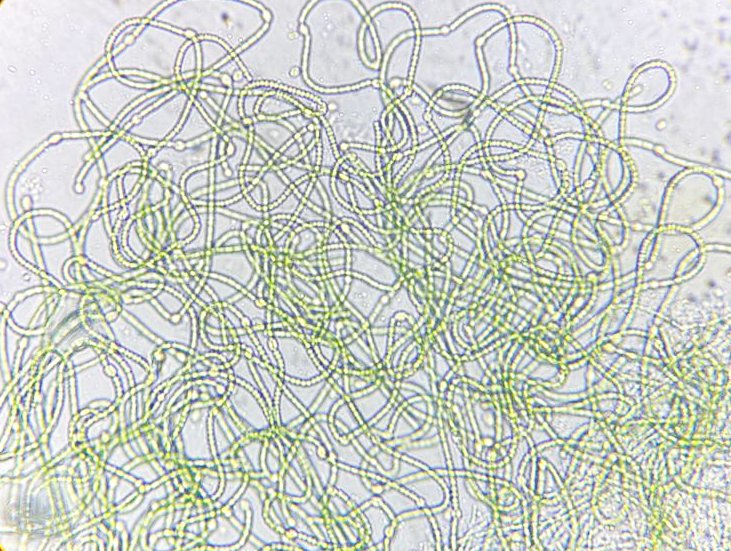
Filamentous colonial prokaryotic organism (cyanobacterium). Cells are spherical or barrel-shaped, lacking flagella, and connected into bead-like unbranched filaments (trichomes) surrounded by a mucilaginous sheath. Forms slimy colonies. Under nitrogen deficiency, it differentiates large spherical heterocysts (6–10 µm). The size of vegetative cells ranges from 3 to 7 µm, classifying the strain within the group of medium-sized microorganisms (2–20 µm).
Cultivation
- culture medium: BG-11 medium; modified nitrogen-free BG-11 medium (liquid and agarized)
- temperature: 25–28 °C
- light intensity: 40–60 µmol photons/m²/s
- photoperiod: 16 h light / 8 h darkness
- pH of the medium: 7.5–8.0
Physiological Characteristics
Halotolerant.
Long-term Preservation Conditions
maintained as a subculture on liquid and 1.5–2.0% agarized nitrogen-free mineral BG11₀ medium. Storage temperature is +12…+15 °C, light intensity is minimal (5–10 µmol photons/m²/s), and the photoperiod is 12:12 h (light/dark). Subculturing of the collection culture is performed every 4–6 months.
Genetic Information
GenBank Accession №PZ747267
Field of Application
Utilized in fundamental research and biotechnology.